Information Over Time in Continual Learners
NeurReps @ NeurIPS 2026DevAI @ NeurIPS 2026
A learner that keeps training on new tasks tends to overwrite what it already knew. Biologically inspired learning rules are often reported to forget less than backpropagation, so I checked whether that advantage survives a fair comparison.
Once learning accuracy is matched and the baseline is tuned as hard as the rule, the retention advantage of local learning rules is under a third of a point, while replay adds about ten. On this protocol, retention tracks learning accuracy rather than locality.
What happens to an old skill when a model keeps training on new ones? The same training that teaches a new task can quietly overwrite an old one, and in a deployed model that is catastrophic forgetting with a cost attached, since the behavior being overwritten can be a capability or a safety property the model had before. Biologically inspired learning rules are often reported to forget less than backpropagation, so I tested whether the advantage survives a fair comparison on class-incremental Split-CIFAR-10. A rule that learns each new task less well also has less to forget, so I first calibrated an instrument, then scored each rule against backpropagation at the same learning accuracy, tuning the baseline as hard as the rule. Feedback alignment and direct feedback alignment matched backpropagation, predictive coding retained 0.21 points more, and replay added 10.6. Any retention advantage from locality on this protocol stays under a third of a point.
01, The Challenge
Why a retention gain needs a matched baseline
A rule that learns each new task less well also has less to forget, so a retention number read on its own confounds how much a method protects old knowledge with how little it learned in the first place. A fair comparison has to hold learning accuracy fixed before it reads off forgetting. Most reports of biologically inspired rules forgetting less than backpropagation skip this step, which is the gap this project closes.
02, The Approach
Calibrate an instrument, then compare at matched learning
I never let a strong rule compete against a weak baseline, so I match the learning accuracy of every method before comparing how much it forgets. Weakening backpropagation along a ladder of settings makes backward transfer almost a deterministic function of learning accuracy, with an R-squared of 0.995, which sets how small a difference I can resolve: a held-out error of 1.09 points. I then score each rule against backpropagation at the same learning accuracy, so a retention gain counts as evidence only once the baseline is tuned as hard as the rule.
03, Results
One finding, and its boundary
A fair baseline erases the retention advantage of local learning rules
NeurReps @ NeurIPS 2026DevAI @ NeurIPS 2026
Scored against backpropagation at the same learning accuracy, feedback alignment and direct feedback alignment matched backpropagation, predictive coding retained 0.21 points more with a 95% interval of [+0.11, +0.31], about a fifth of the instrument's own error, and replay added 10.6 points. Any retention advantage from locality on this protocol stays under a third of a point, while an explicit replay buffer is worth about fifty times as much.
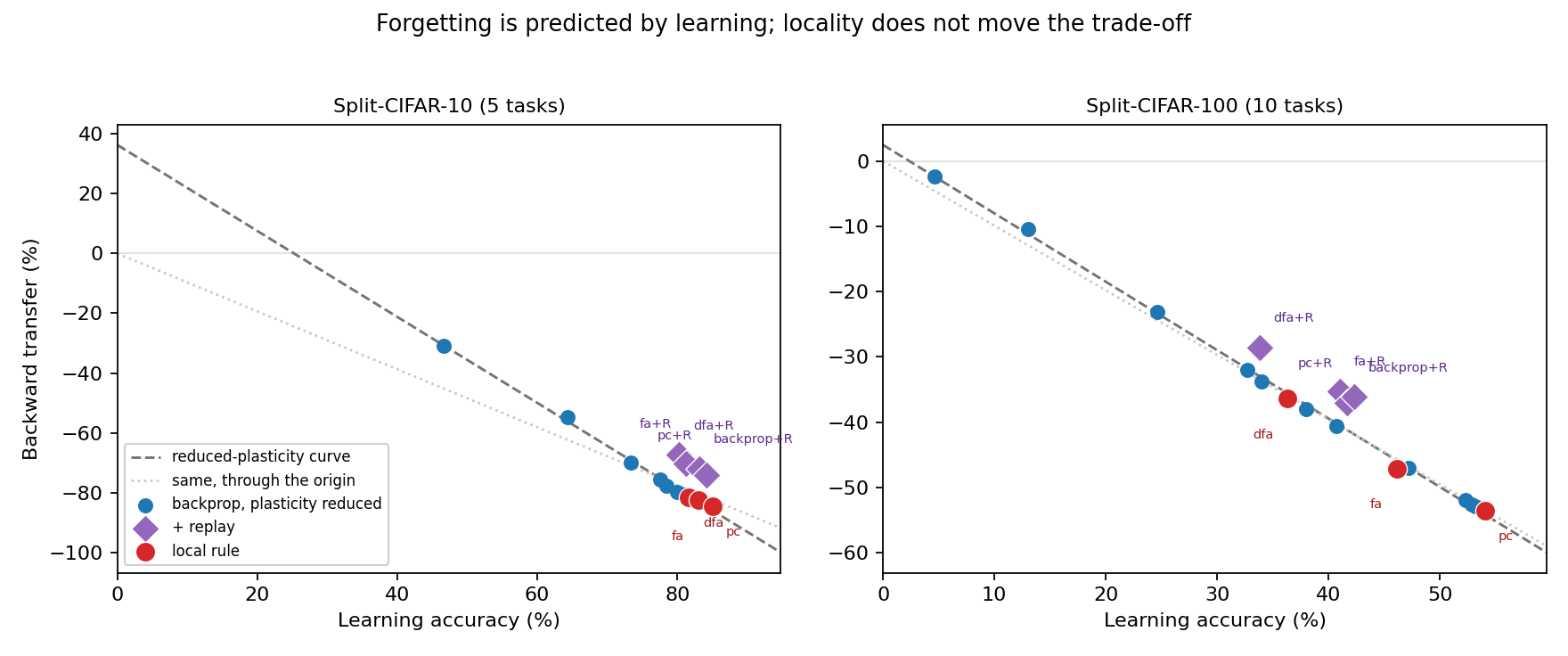
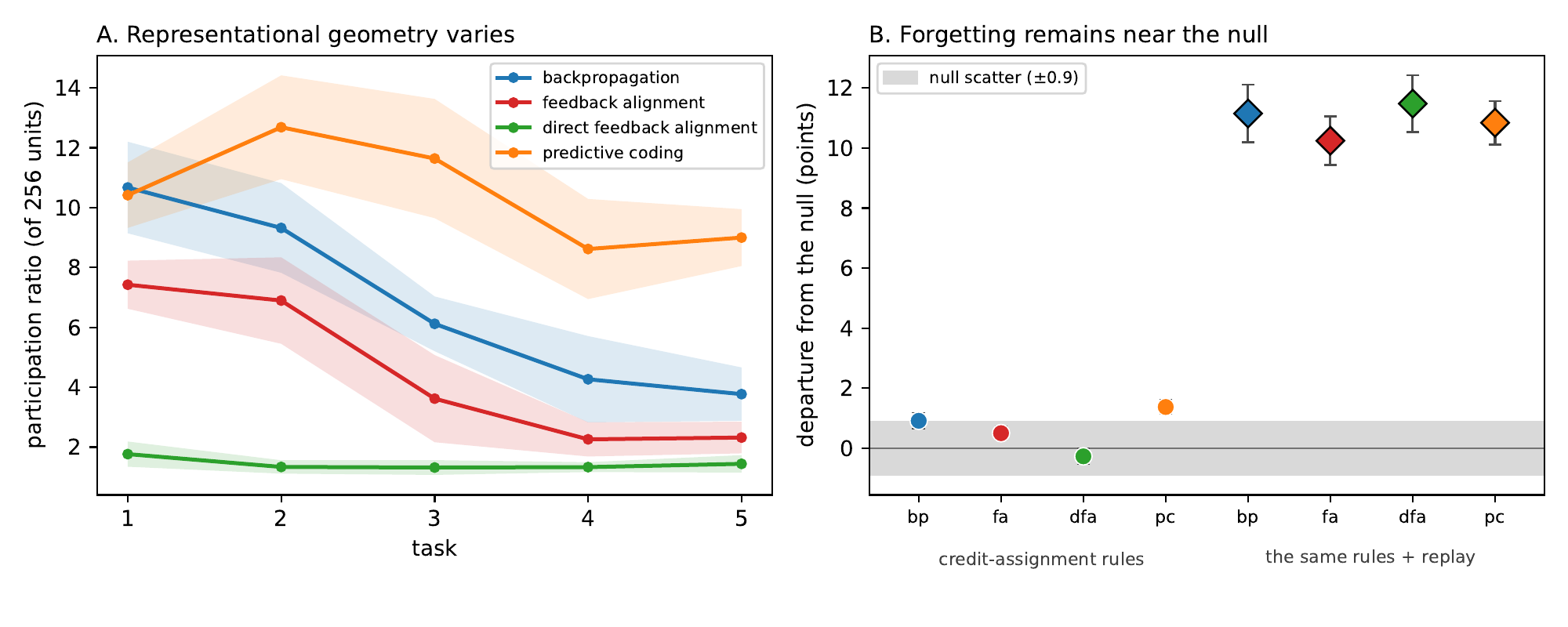
Once learning accuracy is matched and the baseline is tuned fairly, the retention advantage of local rules stays under a third of a point while replay adds 10.6, so on this protocol retention tracks learning accuracy rather than locality.
Continued training of a deployed model, whether fine-tuning or reinforcement learning from human feedback, can erase capabilities and safety behaviors the model had before. That is catastrophic forgetting with a deployment address, and the one constraint this work adds is that any method claiming to protect earlier behavior has to be compared at matched learning of the new task.
Takeaways
What it adds up to
Limitations
This result is scoped to class-incremental Split-CIFAR-10 with a growing head, which sits near a retention floor, and a wider-window replication is the next step. The architectures compared are feedforward convolutional networks, so this speaks to credit-assignment rules under this protocol and leaves recurrent or sequential architectures for later. The code will be released, and the Code link is held until then.