Recurrent Learning in Robot World Models
lightning talk and poster, RoBoWoMo @ IEEE IROS 2026poster, Robotics World Modeling @ NeurIPS 2026
A recurrent world model trained to predict a robot's next observation has to carry an internal state. I study when that state becomes a variable you can read, steer, and that the model's own dynamics actually use, and when a probe is reading something the dynamics set aside.
A predictive world model builds a usable internal coordinate only when the task forces it to: a steerable heading variable appears only under partial observability, and which coordinates the dynamics use is set by what the observation makes separable, not by the actuator count. A probe can read a coordinate that the dynamics set aside.
A world model is a recurrent model trained to predict its own next observation, and to predict well when the world is partly hidden it has to hold an internal state. The interesting question is what that state becomes. If it becomes a clean variable that lines up with something concrete, like which way the agent is facing, you can read it, trust it, and steer it. If it stays a tangle, the model can still predict while carrying nothing you can use. I train action-conditioned world models on a robot's range sensors with no access to its heading, and a steerable heading variable appears only under partial observability: the lowest-fidelity blackout model tracks true heading at a ring-coordinate fidelity of 0.860 while the best control reaches only 0.613, so the two groups separate with no overlap, and the variable behaves like a continuous attractor that is steered causally. A companion study pushes the same question further, showing that a probe can read a coordinate out of the latent state that the dynamics set aside, and that the coordinates the dynamics do use are set by what the observation makes separable, not by the number of actuators.
01, The Challenge
Why an internal variable is the thing to measure
Most work reads structure off a hidden state and calls it understanding, but structure is cheap. A ring can appear in a model whose dynamics ignore heading, so the shape alone leaves the question open. The deciding test is whether the model's own dynamics use the variable, and whether that variable stays faithful at the steps where the model has to integrate without seeing anything. Both studies here hold the measurement to one standard: a ring counts as evidence only once fidelity separates the conditions, and a decodable variable counts as a used one only once the dynamics act on it.
02, Results
Two findings
A steerable heading variable emerges only under partial observability
RoBoWoMo @ IEEE IROS 2026Lightning talk and poster
I train 36 action-conditioned world models on egocentric range observations from a robot moving in a plane, with no pose in the input and none in the loss, and ask whether a heading variable appears on its own. Hidden states form a ring in nearly every condition, and persistent homology finds one in 7 of 8 always-observed models and 7 of 8 shuffled-action controls, which have no way to integrate heading, so ring shape alone leaves the question open. The deciding test is fidelity, how closely the coordinate around the ring follows physical heading at the steps where the model has to integrate without seeing anything. Withholding observations during training lifts that fidelity by 0.421 on average over a matched shuffled-action null, with all 12 paired differences positive and the smallest of them 0.293, and the lowest-fidelity blackout model, at 0.860, still beats the highest-fidelity control, at 0.613, so the 36 models separate with no overlap.
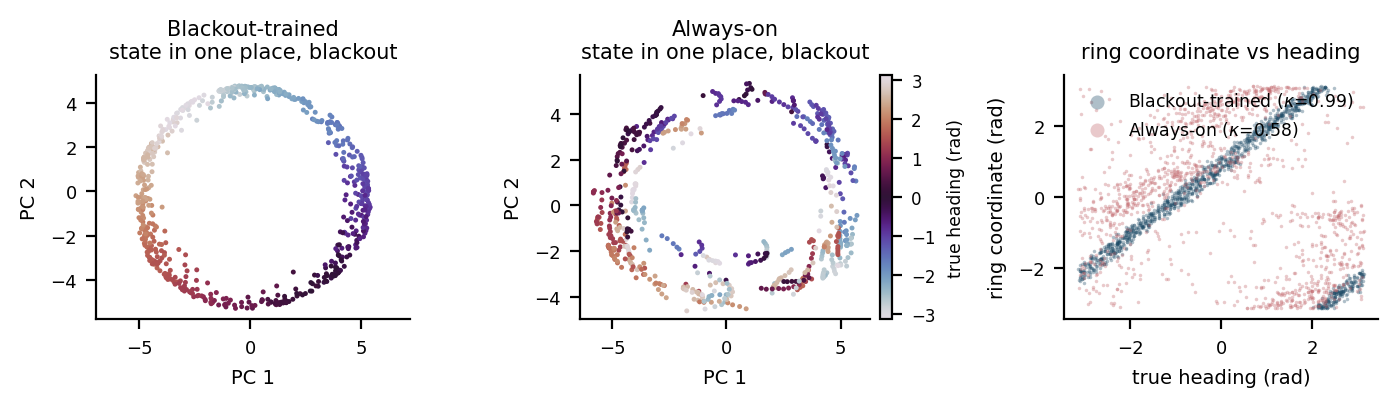
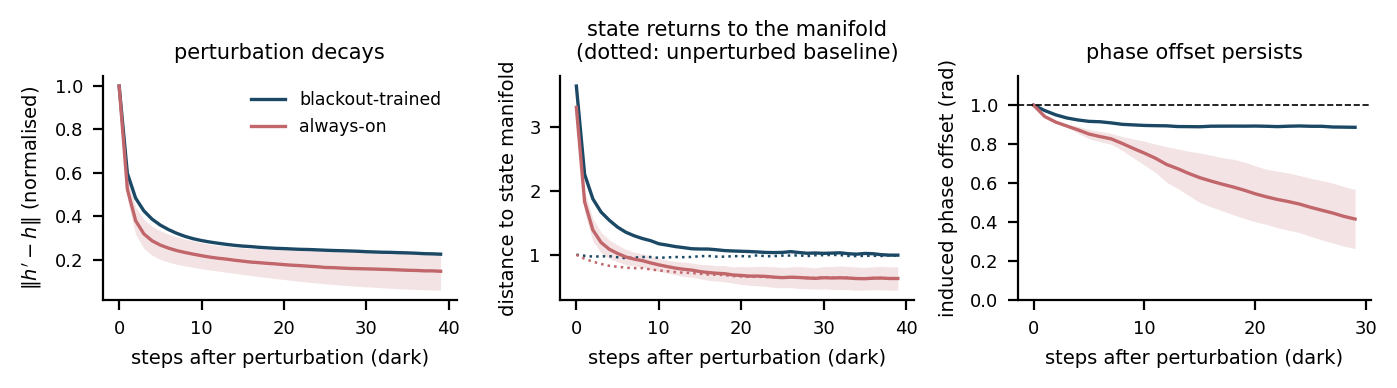
The steerable ring behaves like a continuous attractor, which is the structure neuroscience proposes for head-direction cells. A perturbation off the ring decays back to it, while a shift in position along the ring is held rather than erased. Rotating the ring plane changes the model's predicted observation to the one for the rotated heading, at a gain of 0.897 and an R-squared of 0.998, so the variable is used causally, beyond mere correlation with heading. The shuffled-action null also steers, at a gain of 0.735, so the separation between the conditions rests on fidelity rather than on steering alone.
With no pose supervision, a predictive world model builds a heading variable that tracks true heading only under partial observability, where the lowest blackout model reaches 0.860 against 0.613 for the best control and the 36 models separate with no overlap, and the variable is a causally steerable continuous attractor.
Decoding and use are separate properties
Robotics World Modeling @ NeurIPS 2026Poster
The heading result raised a sharper question. A probe can read a variable out of a model's latent state even when the model's own transition dynamics act on a different one, so decoding and use are different properties. To tell them apart I built a label-free test that uses only actions and the frozen model's own predictions: a candidate coordinate is a plane in the latent space, and the test asks whether rotating the state inside that plane reproduces the effect of an extra action, judged against a variance-matched null. A coordinate the dynamics use passes; a coordinate that is only decodable stays within the null. In the shuffled-action control from the heading study, heading decodes to within 20 to 24 degrees, yet the conjugate plane sits 69 to 83 degrees away, so the variable lives in a decaying trace of the last observation while the dynamics act elsewhere.
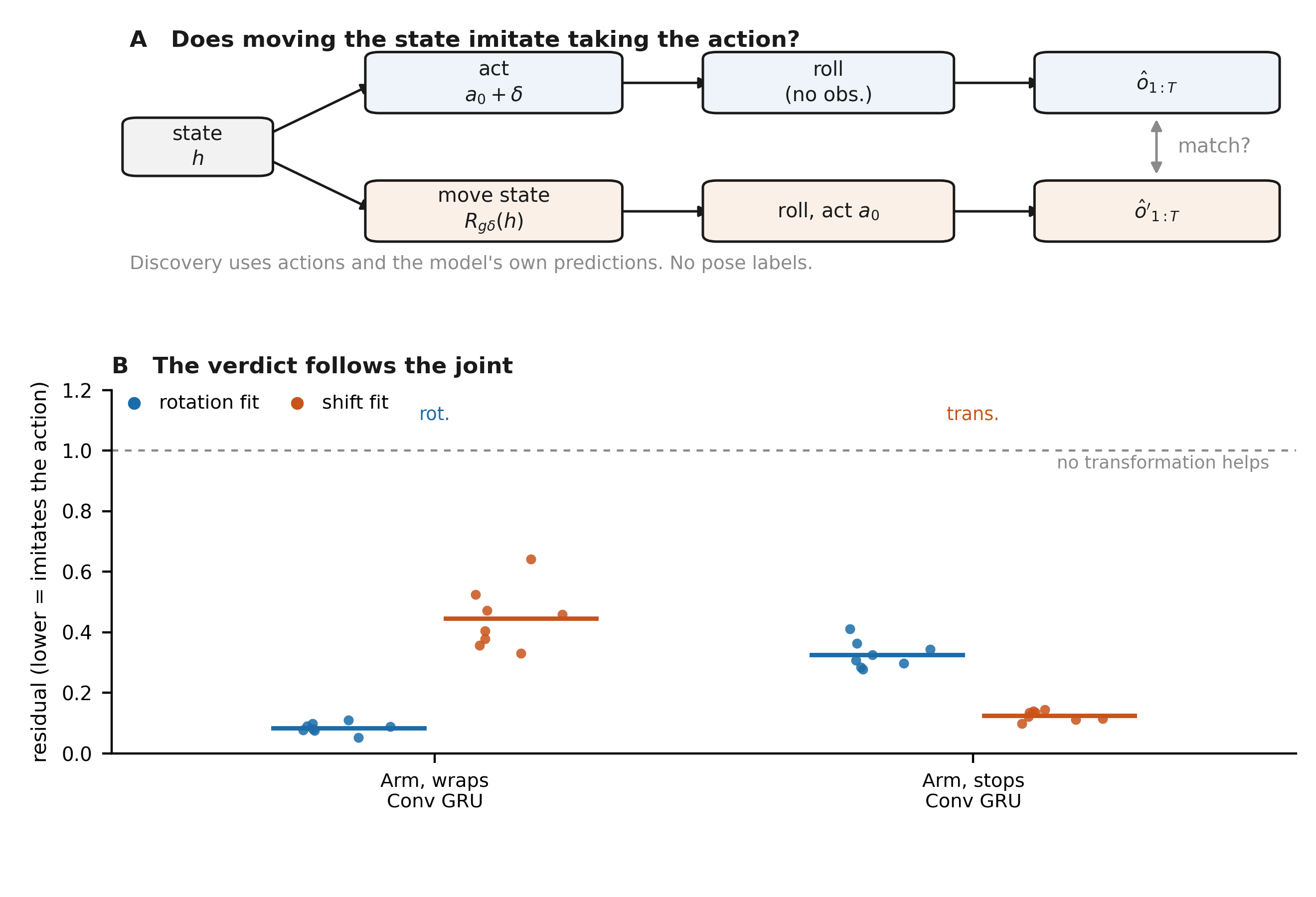
Which coordinates a model builds is decided by the observation, not the actuators. I trained the same model on three two-joint arms that differ only in how the image depends on the joints, with dynamics, action space, image size, sensor noise, architecture, training budget, and the estimator held fixed. The coordinate the model builds follows what the image makes separable.
| Environment | What the image depends on | Coordinates built |
|---|---|---|
| Serial arm | q1 and q1+q2, proximal dominant | One, at (1,0) |
| Parity arm | q1+q2 only | One, at (1,1) |
| Decoupled arm | q1 and q2 separately | Two, at (1,0) and (0,1) |
Decoding and use come apart: a coordinate can be read from a world model's latent state while its dynamics act on a different one, and the coordinates the dynamics do use are set by what the observation makes separable, a serial arm gives one coordinate, a parity arm one, and a decoupled arm two. Both joint angles decode in every case, but the proximal joint's conjugacy margin is six times the distal joint's, so the observation, not the actuator count, sets the number of coordinates.
Takeaways
What both studies share
Limitations
The heading study is in simulation on a planar robot with range sensors, so whether the same faithful variable appears from richer sensing or on hardware remains for later work. The coordinates study is established for 16x32 synthetic RGB, small convolutional GRUs, and two degrees of freedom, and the criterion as implemented tests a planar rotation, one group action among many, so non-circular coordinates, a comparison with the probing or activation-patching literature, and real robots and real video stay out of scope.
Cite